

Compression for Beginners Part 3: Optical

Optical compression is a natural next step after FET, because it shows the other side of the spectrum. If FET compressors are about speed, edge, and control, optical compressors are about smoothness, tone, and feel. They don’t react as quickly, and they don’t try to. Instead, they move in a way that tends to sound more forgiving and more “musical” right out of the gate.
At a technical level, an optical compressor uses a light source and a light-dependent resistor to control gain reduction. As the incoming signal gets louder, the light becomes brighter, which in turn causes the compressor to reduce gain. When the signal drops, the light fades and the compression eases off. That might sound simple, but the important part is how that light behaves. It doesn’t react instantly, and it doesn’t return to zero in a perfectly linear way. It has a kind of natural lag and curve to it, and that behavior is exactly what gives optical compressors their signature sound.

The most well-known example of this design is the Teletronix LA-2A. Originally developed in the 1960s and later refined under Universal Audio, it has become one of the most widely used compressors in recording history. Unlike something like an 1176, which gives you a handful of controls to fine-tune behavior, the LA-2A is almost stripped down to the essentials. You’re essentially given a peak reduction knob and a gain knob, and that’s about it. There’s no attack or release control to tweak, at least not directly. The unit decides that for you. That simplicity is part of the appeal. You don’t spend time dialing in timing parameters—you listen and adjust until it feels right. And more often than not, it just works. The attack is relatively slow compared to a FET compressor, which allows transients to pass through more naturally. The release is program-dependent, meaning it changes based on how the compressor has been driven. After a loud section, it may take a bit longer to recover, while lighter compression releases more quickly. This creates a very smooth, almost “breathing” quality that tends to follow the performance rather than fight it.
Because of this behavior, optical compressors are often associated with leveling rather than peak control. They don’t clamp down aggressively on fast transients, but they excel at gently bringing a performance into a more consistent range over time. Vocals are the classic example. A good vocal performance can have a wide dynamic range, and an optical compressor can help even that out without making the compression obvious. It smooths things over rather than reshaping them. There’s also a tonal aspect to consider. Many classic optical compressors, including the LA-2A, use tube circuitry, which introduces a bit of harmonic richness. It’s subtle, but it adds weight and warmth, particularly in the midrange. This is part of why optical compression is often described as “thick” or “creamy.” It’s not just the way it controls dynamics—it’s the way it enhances the body of a sound.
In practice, optical compressors tend to show up on sources where you want control without drawing attention to the process. Vocals are the obvious choice, especially in genres where the performance needs to feel natural and connected to the listener. Bass is another common use case. An optical compressor can help smooth out inconsistencies in playing while keeping the low end feeling round and stable. It’s also not uncommon to see them used on guitars, keys, or even mix buses when a more gentle form of glue is needed.
Where they don’t tend to shine is in situations that require fast, precise control. If you have a signal with sharp, aggressive peaks that need to be caught immediately, an optical compressor may let too much through. That’s where something like a FET or VCA compressor would be a better fit. Optical compression is less about catching every transient and more about shaping the overall contour of a performance.
One of the most common approaches in mixing is actually combining compressor types, and this is where the contrast between FET and optical designs becomes especially useful. A FET compressor can be used first to catch fast peaks and add presence, followed by an optical compressor to smooth everything out and add weight. Each one handles a different part of the job, and together they create a more controlled but still natural result. It’s a technique you’ll see referenced often because it works across a wide range of sources, especially vocals.
There are still a few things to watch out for. Because optical compressors are so smooth, it’s easy to overdo it without immediately noticing. You might end up with something that feels too flat or too controlled over time, even if it sounded good in the moment. It’s also worth remembering that they won’t fix tonal issues. If something is muddy or harsh going in, compression will tend to emphasize that rather than solve it. What optical compression really teaches is restraint. It encourages you to listen for feel rather than just control. Instead of focusing on how much gain reduction you’re applying, you start paying attention to how the performance sits, how it moves, and whether it feels connected from start to finish. It’s less about forcing a sound into place and more about guiding it into a more consistent and musical shape.
If FET compressors introduce the idea that compression can add energy and attitude, optical compressors show that it can also add cohesion and stability. They don’t demand attention, but they quietly improve the way a track sits in a mix. And once you hear that, it becomes a tool you reach for not because something is wrong, but because you want something to feel right.
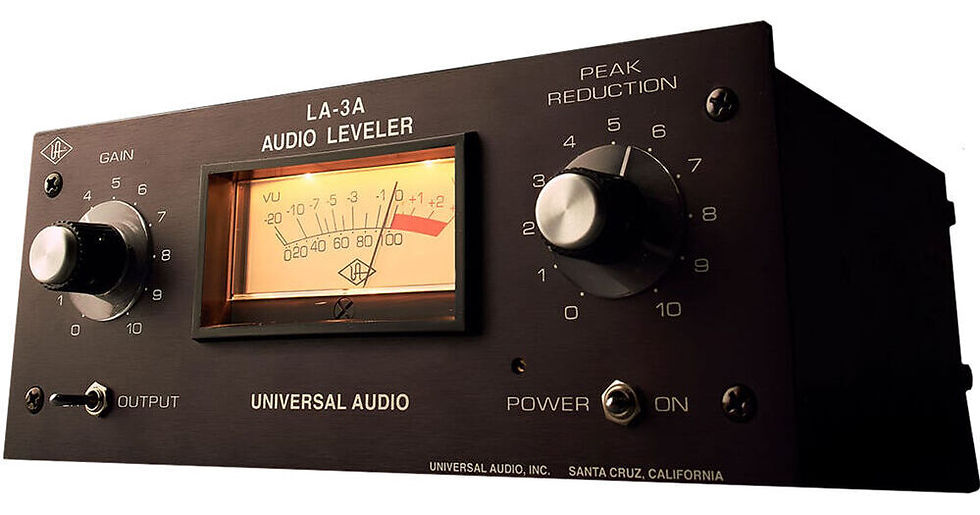
While the most iconic of all is the Teletronix LA-2A, closely related is the Teletronix LA-3A, which keeps the optical behavior but swaps the tube circuitry for a solid-state design. The result is a slightly faster, more forward sound that sits somewhere between the smoothness of an LA-2A and the punch of a more aggressive compressor.

Another respected piece is the Tube-Tech CL 1B, which has become especially popular in modern vocal production. It maintains the smooth, leveling behavior of optical compression but offers more control, making it a bit more flexible in practice.
On the plugin side, nearly every major developer has their own take on these units, and the differences usually come down to how closely they model the original hardware versus how much modern flexibility they introduce. The Universal Audio LA-2A Collection is widely regarded as one of the most faithful recreations, offering multiple revisions with slightly different tonal characteristics. Waves CLA-2A is another popular option, known for being quick to dial in and immediately usable in a mix. Plugin Alliance elysia alpha compressor leans more into modern control while still offering smooth compression characteristics, though it extends beyond traditional optical behavior.
There are also more modern interpretations that expand on the concept. Softube Tube-Tech CL 1B brings the flexibility of the hardware version into the box, while Arturia Comp TUBE-STA combines optical-style behavior with additional controls like sidechain and tone shaping. Even IK Multimedia White 2A offers a solid, no-frills take on the classic sound.
The important thing to understand is that while these plugins may look different and offer slightly different features, they are all rooted in the same core behavior: slower, smoother, program-dependent compression that follows the performance rather than aggressively controlling it. Once you recognize that sound, it becomes much easier to choose the right tool, regardless of the brand name on the interface.
At this point, the goal isn’t to collect every version available, but to become familiar with how one or two of them respond. Once you understand what optical compression feels like—how it moves, how it smooths, how it adds weight—you’ll start reaching for it with intention rather than habit. And that’s really the shift this stage of learning is all about.
Stay Tuned for Part 4: VCA Compressors. Let me know in the comments if you have a go to OPtical compressor! What do you use it on most commonly?
Cheers,
Cory


Comments